Henry William Thompson
HANK THOMPSON
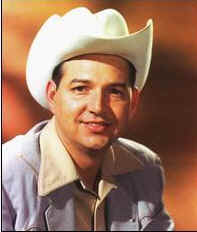
Like many country stars, Henry William Thompson took an early interest in music, winning several amateur contests on the harmonica. After he became enthralled by cowboy movie idol Gene Autry, however, the guitar became Thompson’s instrument of choice. With a Christmas present from his parents, a four-dollar guitar bought at a secondhand store, young Hank was on his way. By the time he finished high school he was broadcasting over radio station WACO as Hank the Hired Hand, sponsored by a local flour company.
After graduating, Thompson enlisted in the U.S. Navy. While stationed in San Diego, he persuaded his superiors to let him play area clubs, and after putting out to sea, he entertained his shipmates as well. He kept on broadcasting, too, over a network of small stations organized by American military personnel in the South Pacific. While in the navy he also took advantage of training programs and studied electrical engineering at Southern Methodist University, the University of Texas, and Princeton University—making him one of country music’s better-educated stars.
Although he pondered an engineering career after his navy stint was over, radio work and his first hit record, “Whoa Sailor,” kept him on a show business track. Assisted by prominent DJ Hal Horton of the 50,000-watt KRLD in Dallas, this Globe Records release became a minor regional success. Thompson also recorded four sides with the Blue Bonnet label before Tex Ritter, then a prominent star on Capitol Records, helped him gain a contract with this larger, major label. During 1948–1949 Thompson justified Ritter’s faith in him with hits such as “Humpty Dumpty Heart” (based on the children’s nursery rhyme), “Green Light,” and a remake of “Whoa, Sailor.”
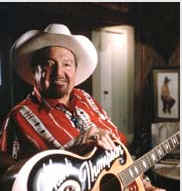
During the 1950s Thompson’s songwriting talents,
gravelly baritone, precise diction, and powerful combination of western
swing and honky-tonk sounds helped him continue his string of hits. The
year 1952 brought his first ..1 disc, “The Wild Side of Life,” a song
that inspired the hit that launched Kitty Wells’s career: “It Wasn’t
God Who Made Honky-Tonk Angels.” Subsequent Thompson chartmakers of the
1950s included “Waiting in the Lobby of Your Heart,”
“Rub-A-Dub-Dub,” “Yesterday’s Girl,” “Wake Up, Irene,”
“Honky Tonk Girl,” “Most of All,” “The Blackboard of My
Heart,” and “Squaws Along the Yukon,” all in the Top Ten.
During these years Thompson also made inroads into television, hosting a
variety show on WKY-TV in Oklahoma City from 1954 to 1957. In addition, he
was one of the earliest country performers to entertain in Las Vegas
showrooms, and he recorded one of country’s first live albums, Live at
the Golden Nugget, there in 1960. Meanwhile, he brought his engineering
knowledge to bear on his stage show and built top-flight sound and
lighting systems that heightened his drawing power at the more than 250
show dates he typically played each year. Thanks to his musical and
technical leadership, his Brazos Valley Boys were Billboard’s top-ranked
band from 1953 to 1965, a record that has yet to be equaled
Into the 1960s and beyond, Thompson’s easy manner made him a welcome guest on network TV variety shows, as did a dynamic stage presence magnified by his size (he stands six feet, two inches tall); a rough-hewn, handsome appearance; and custom-made western outfits for which he became famous. But following “A Six Pack to Go” (..10, 1960) and “Oklahoma Hills” (..7,1961), he didn’t make the Top Ten again until 1968’s “On Tap, in the Can, or in the Bottle” and “Smoky the Bar,” both recorded early in his association with Dot Records, which he began after a brief stay at Warner Bros. in the late 1960s. Two more Top Ten hits came in 1974, but the 1970s belonged to country pop, and Thompson’s chart success dwindled to the point where he pared down his road schedule and spent more time hunting or tending to his various real-estate, broadcasting, and music publishing interests.
Hank Thompson was elected to the Country Music Hall of Fame in 1989. He still performs some 120 dates a year throughout the world. —John Rumble
adapted from the Country Music Hall of Fame® and Museum’s Encyclopedia of Country Music, published by Oxford University Press
| Album: Hank
Thompson Salutes Oklahoma Year: 1969 http://www.google.com/musicl?lid=_H_08oDIo9P&aid=8lEBhjv5GJO |
||
| 1. | Oklahoma Hills | |
| 2. | Dusty Skies | |
| 3. | Dear Okie | |
| 4. | Oklahoma Home Brew | |
| 5. | Everlasting Hills of Oklahoma | |
| 6. | Take Me Back to Tulsa | |
| 7. | Guthrie | |
| 8. | Happy Oklahoma | |
| 9. | O-K-L-A-H-O-M-A | |
| 10. | Homesick Lonesome Oklahoma Okie | |
| 11. | Big Boat Across Oklahoma | |
| 12. | Oklahoma Stomp | |
http://www.cmt.com/news/articles/1573479/20071105/thompson_hank.jhtml
Country Music Hall of Fame member Hank Thompson has announced his retirement from a career that has spanned seven decades. Thompson, 82, was released from the hospital Wednesday (Oct. 31) after being diagnosed with an undisclosed illness. He is recovering at his home near Fort Worth, Texas. A honky-tonk singer and leader of his band, the Brazos Valley Boys, Thompson scored a total of 29 Top 10 singles, including "The Wild Side of Life," which spent 15 weeks at No. 1 in 1949. Other hits include "Humpty Dumpty Heart," "Rub-a-Dub-Dub" and "A Six Pack to Go." Thompson, who has canceled all of his tour dates, last performed on Oct. 8 in Waco, Texas, his birthplace.