The Norman Transcript
Norman, Cleveland County, Oklahoma
October 31, 2007
David Payne refused to accept denied access to Indian lands
By David Dary
For The Transcript
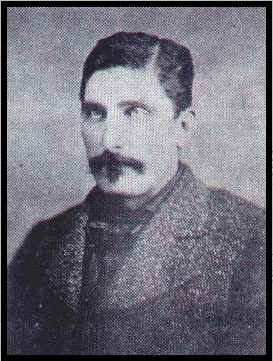
http://en.wikipedia.org/wiki/David_L._Payne
Captain David L. Payne was an adventurer, scout, soldier,
politician, and a Boomer, someone who wanted to settle in Indian
Territory, a region set aside only for Indians.
Many people call Payne the “Father of Oklahoma,” but others
oppose the title because Payne died six years before Oklahoma
Territory was formed in 1890 and because his
actions as a Boomer suggest he ignored the rule of law.
David Payne was born on a farm in Grant County, Indiana, on
December 30, 1836, He attended a rural school near his home. In
the spring of 1858 Payne and his brothers
left Indiana to fight in the Mormon War. As they headed west
across Illinois and Missouri, David Payne’s desire to fight
waned.
Crossing the Missouri River into Kansas Territory, David Payne
found beautiful wooded country in Burr Oak Township, Doniphan
County, in northeast Kansas. At age 22 he acquired some land and
built a sawmill. His business, however, soon failed. He turned
to hunting wild game to survive. He became a good hunter and
learned to read signs. Impressed with his skills, neighbors
hired him to do their hunting. In time, the federal government
hired him as a scout on several expeditions. One of them took
Payne into what is now Oklahoma in the 1850s.
When the Civil War began, Payne enlisted in the 4th Kansas
Volunteers created to protect settlers from Indians. In April
1862 Payne’s regiment was consolidated with another unit
creating the 10th Kansas Infantry, which saw action in Kansas,
Missouri, Arkansas and Indian Territory. Payne and 386 other men
in the 10th joined more than nine thousand other Union soldiers
in the Army of the Frontier and fought in the Battle of Prairie
Grove that secured northwest Arkansas for the Union.
Payne left the army in August 1864 and returned to Kansas where
he was elected to the Kansas legislature serving in the 1864 and
1865 sessions. In March 1865 he joined for one year the 10th
Kansas Cavalry organized by the legislature to protect settlers
from Indians in western Kansas. After his year, he answered a
call from Kansas Governor Samuel Crawford for volunteers to stop
Indian attacks in Kansas. Payne was appointed a captain of
company D of the 18th Kansas Cavalry.
In `1867, Payne became postmaster at Fort Leavenworth, Kansas,
but in the fall of 1868 he joined the army again. He became a
lieutenant in the 15th Kansas Cavalry and served in the winter
campaign against Indians during 1868 and ’69. For a time he
served as a scout for General Philip Sheridan. When his tour
ended in 1870, Payne moved to south central Kansas. A year
later, he again was elected to the Kansas legislature. Later, in
1875 and 1879, Payne served as assistant to the Doorkeeper in
the U.S. House of Representatives in Washington, D.C.
There Payne became friends with Elias C. Boudinot, a Cherokee
working as a lobbyist for the railroads who wanted to lay their
tracks through Indian Territory. President Rutherford B. Hayes
opposed white settlement in Indian Territory. He declared it was
unlawful white settlers to entry the territory. Hayes’ action
gave supporter of white settlement a chance to rally.
Attracted to the movement, Payne returned to Kansas where he
learned that another Boomer, Colonel C. C. Carpenter, had taken
a party of settlers from Coffeyville, Kansas, into Indian
Territory. After they reached the North Canadian River, soldiers
escorted the group back to Kansas.
Payne organized his own party and entered Indian Territory and
laid out a town site where Oklahoma City stands today. Soldiers
arrested Payne and his group, took them to Fort Reno, and then
escorted them back to Kansas. Payne resented the fact federal
law
prohibited the military from interfering in civil matters.
In July 1879, Payne took another party back to the site of
Ewing. Again soldiers arrested them and this time took them to
federal court at Fort Smith, Arkansas. Judge Isaac Parker ruled
against Payne and fined him $1,000.
Payne did not give up. He organized other parties in southern
Kansas that tried unsuccessfully to settle in Indian Territory.
He even founded the Oklahoma War Chief to promote the cause.
On one of his trips soldiers seized Payne’s printing press,
burned a building, and again took Payne and his group to Fort
Smith.
The public began to complain about the military’s treatment of
Payne and the others. The case was turned over to the U. S.
District Court in Topeka, Kansas. Judge Cassins G. Foster
quashed the charges and ruled that settling on the Unassigned
Lands was not a criminal offense. Payne’s group cheered, but
the government did not immediately accept the court’s ruling.
Payne continued to work for opening Indian Territory to
settlement. He gave many speeches. His last was in Wellington,
Kansas, on November 27, 1884. The next day he died of heart
failure at about age 48. Thousands of people attended the
funeral in the Methodist Episcopal Church at Wellington and
visited his grave in a local cemetery.
Payne did not live to see white settlement occur in Indian
Territory. The Unassigned Lands were not opened to settlement
until 1889 four years after Payne died. His grave remained in
Kansas until 1995 when his remains were moved to Oklahoma. A
monument was dedicated over the new grave in Stillwater, Payne
County, named in his honor
WORKS CITIED
http://www.normantranscript.com/centennialokla/local_story_304115124.html