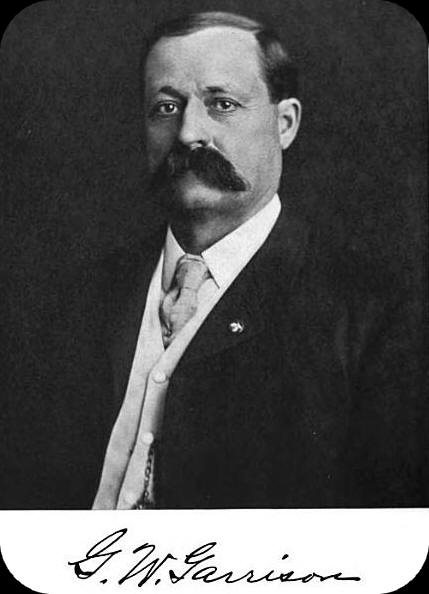
George W. Garrison
On June 5, 1908 about 6 pm G. W. Garrison, sheriff of Oklahoma County, was shot by the defendant [Alf Hunter alias James Kingsbery], and almost instantly killed. Sheriff Garrison, learning the defendant who was charged within Oklahoma County on May 21, 1908 of killing Susie Pride, was in Blaine County. left Oklahoma County to serve the warrant, accompanied by deputies Tod Warden and M.L. Sanders. They proceeded by train to Watonga, where they were joined by G. A. McArthur, sheriff of Blaine county and his deputy, M. B. Skeen.
They procured buggies and drove to Hitchcock and from there to the place of a negro named Dobbs about three miles from Hitchcock, where the defendant and Ed Ellis, another negro, were employed chopping cotton.
source: books.google.com "3 Oklahoma Criminal Reports" [Cases Determined in the Criminal Court of Appeals of the State of Oklahoma, Sept 21, 1909-May 23,1910; Howard Parker, State Reporter; Hunter v State; p.534-539
photo source:
History of Oklahoma Thoburn
George W. Garrison. The sheriff's office in Oklahoma county during the last few years has made a record that indicates the status of law and order in the county. and also brings into prominence one of the most courageous and high-minded criminal officers the southwest has ever known. The death of Sheriff George `W. Garrison. who was killed by Alf. Hunter. a negro despera-do, near Hitchcock, June 5. 1908. is said to have caused more excitement on the streets of Oklahoma City than any event since the early days, when a concourse of indignant citizens under arms was a not extraordinary event. Sheriff Garrison died in the performance of duty. and there is little doubt that during the course of his long career in hunting criminals he had become ex-pectant of such a death. and was indiffer-ent or resigned to the perils of his daily occupation. On May 19. Alf. Hunter had killed Mrs. Susan Pride in Oklahoma City.
and had been a fugitive from justice until Sheriff Garrison with a posse of deputies had found him in the hills north of Watonga. A desperate pistol fight ensued during which the sherili' was instantly killed and M. R. Sanders. a deputy of Arcadia, was wounded. This tragedy closed the career of one of the most useful and picturesque ofhcials of Oklahoma. Immediately alter his election to the of-fice of sheriff in 1904, George W. Garrison organized the affairs of his ollice on a good business basis, and commenced systemat-ically to run down many old criminals who had hitherto escaped the law. As stated by a public print. he “spent his own salary trying to enforce the statutes of Oklahoma. not merely depending upon what the law paid him for his services. Upon many occasions he _has gone down in his own pocket and paid out money that there might he law enforcement in Oklahoma county, and an up-lift in the morals of the community in con-sequence. It is conceded on all sides that he is a very strong character. that he is very popular, and that his popularity is not merely to be found within his own party (the Democratic). He has tried to give the people of this county a moral adminis-tration, and his friends can point with pride to the fact that the improvement of moral conditions is in a great measure due to him. No one has ever been able to point to anything dishonest, either in the private life or the public career of George \V. Gar-rison." The above was written toward the close of Mr. Garrison's first term. and. since his rc-election in 19Q6. applied to him and to 'll’lr."(iari-ison had ifxperiéricfpractically all his life as a criminal officer. While still a boy, at Fort Smith. Arkansas, he was appointed and served as an oflicer under the U. S. marshals. He had to deal with many notable cases. One of them that will be readily recalled by the citizens of Oklahoma county was that involving the pursuit and killing of the outlaw Billy Isabel, which occurred during his term as sheriff. Eight or nine years before Mr. Garrison became sheriff this man had committed two murders in Oklahoma county. and was also wanted for crimes in Texas. He had taken refuge in the almost inaccessible mountainous country of the Choctaw Nation, and. secure in his isolation and in the awe felt by his few neighbors for his prowess, he had occasionally taunted the officers of Oklahoma county. writing that if they ever took him they would have to take him in a box. One of these letters fell into Mr. Garrisorr’s hands after he became sheriff. Without hesitation he secured a new warrant for Isabel from judge Burwell, and with Deputy Sheriff Bartell of Oklahoma City set out for South McAlester, where he secured the co-operation of the U. S. marshal°s office, Deputy U. S. Marshal _lim Dowell joining them there. At Hartshorne they hired a rig for the ostensible purpose of going out hunting. but drove to the retreat in the hills that Isabel had picked out for his headquarters. They waited about the out-law's house until daylight, when one of the party, pretending that he was a cattle buyer, learned from Mrs. Isabel that her husband had gone fishing and would not return till evening. The officers picketed the house till evening. when Isabel returned home and was shot dead by Deputy Bar-tell, who was guarding the path taken by the outlaw. Sheriff Garrison was horn in Gilmer, Upshur county, Texas, September 20, 1857. In 1862 he came with his parents to Gray-son county, that state, where the family located, his father at that time, and through-out the Civil war. being a soldier of the Confederacy. In the fall of 1866 the fam-ily moved to Charleston, Arkansas, a short distance below Fort Smith where the boy was reared and educated. From here he returned to Texas in 1883, locating at Sunset in Wise county, and therewith began another interiieer. Wise county at that time was so in-fested with criminals that Mr. Garrison and a number of his neighbors organized a vigilance committee to deal with them, and succeeded in a measure in breaking up the open outlawry that plagued that district. Situated twenty miles from railroad, and on what was still a part of the Texas frontier, the community was exposed to criminals as dangerous as any on the Texas border. Owing to the skill and energy displayed by Mr. Garrison in this organized effort to sup-press the border outlaws, he was appointed in 1884 as deputy sheriff under Tom Allen of Wise county, one of the notable sherifls of westem Texas and soon afterward was also appointed deputy under Sheriff Eli Mc-